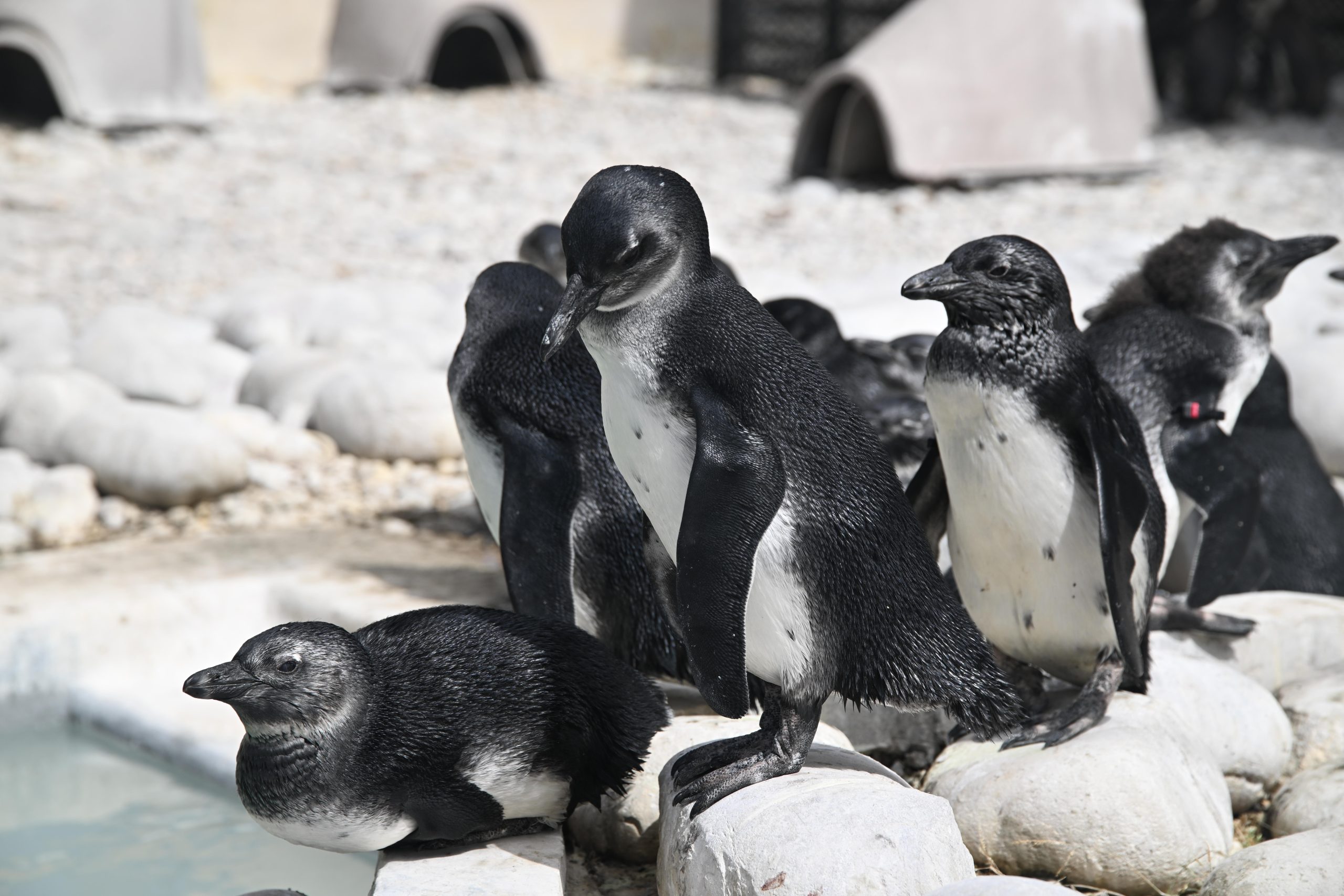
On Wednesday, 12 November, twelve African penguin chicks and one adult were released back onto Dyer Island, their home colony. These birds had been removed by conservation partners CapeNature and the Dyer Island Conservation Trust/African Penguin and Seabird Sanctuary (APSS), because their parents were moulting and unable to feed them. With African penguins declining sharply, every chick counts, and timely intervention is essential.
Why moulting puts young penguins at risk
The tiniest chick, rescued a month ago at 970 grams, has now grown to a healthy 3 kilograms under the dedicated care of Senior Bird Rehabilitator Xolani Lawu, his team, and veterinarian Dr Annamarie Roberts. The chicks learned to swim in preparation for their first ocean swim. With a big swell rolling in, Marine Dynamics’ vessel Happy Feet carried the precious cargo to Dyer Island, crewed by Marine Biologist Amy Webber and Skipper Dickie Chivell.
African penguins undergo an annual moult during which adults are unable to swim or forage, leaving their chicks vulnerable if the moult overlaps with breeding. Each year, some chicks risk starvation. Since the start of the 2025 season, 32 chicks have been safely removed for care at APSS.
Intensive care helps chicks recover
Daily feeding is resource-intensive. The chick crèche consumes six boxes of premium sardines daily, with each box costing approximately R150. Once healthy, chicks are carefully returned to their families on Dyer Island.
Public support keeps the work going
“The penguin life cycle is timed by nature, but human impacts mean some chicks cannot survive without intervention,” says Wilfred Chivell, CEO of Marine Dynamics and Founder of the Dyer Island Conservation Trust. “These birds are the honey badgers of the ocean. Resilient, feisty and remarkable. Every chick we save counts.”
Support from the public is vital. Thanks to the KruShan Foundation, Shannon and Kruger du Plessis launched a campaign raising nearly R30,000 to feed the “pooping troopers.” Xolani adds, “At APSS, we provide care and habitats, but it is public generosity that makes this work possible.”

Penguin numbers continue to decline
African penguin populations have dropped from 141,000 breeding pairs in 1956 to 19,000 today, a loss of nearly 90 percent. Parents forage up to 30 kilometres from Dyer Island and prioritise their own survival over that of their chicks during moulting, leaving vulnerable chicks at risk. The Dyer Island Conservation Trust steps in to bridge this gap, ensuring chicks receive enough food and care to thrive.
How the trust protects vulnerable chicks
The public can help by donating to the Fishy Fund, visiting the sanctuary, donating old towels or newspapers, or supporting artificial nests to improve breeding success. Every act of support protects these charismatic birds and South Africa’s natural heritage.
Simple ways the public can help
Account Type: FNB Platinum Business Account
Account Number: 62568492343
Branch Name & Code: Hermanus, C.P. 247 / 200412
Swift Code: FIRNZAJJ
Reference: Fishy Fund
Visit and support the sanctuary
The African Penguin and Seabird Sanctuary in Kleinbaai is open daily from 09:00 to 16:00. Visitors can observe the penguins through one-way glass and support the sanctuary’s work while enjoying coffee and cake.
Contact: Christine Wessels, 066 185 0860, pa@marinedynamicstravel.com